Quick answer
If you break down on the A14, get onto the verge or a lay-by, hazards on, everyone out away from traffic and behind the barrier, then call. Rapid Recovery covers the A14 near Kettering and Corby 24/7 on 07598 314366. In a live lane, call 999.
On this page
Why the A14 needs extra care
The A14 runs past Kettering and is a busy freight route. Much of the traffic is heavy goods vehicles travelling at speed, and like many fast dual carriageways, it doesn't always give you a hard shoulder to stop on. The same goes for other fast dual carriageways around Corby and Kettering, and for busy A roads like the A43 and A6003.
On roads like these, a stationary car is at real risk. Drivers behind may not realise you have stopped until they are very close. That is why the advice for fast roads is different from what you would do on a town street. This guide focuses on fast roads. For general advice, read what to do if you break down.
If you feel the car going wrong
Act early. The moment a warning light comes on, the engine loses power, or you feel a tyre going, start moving left.
- Indicate left and get into the inside lane.
- Look for a way off: an exit slip road, a lay-by, an emergency area or a wide verge. Leaving the main carriageway is always the best result.
- If you can't reach one, pull as far left onto the verge as you safely can.
- Hazard lights on as soon as you stop, and sidelights too if it is dark or visibility is poor.
- Turn the wheels towards the verge and put the handbrake on.
Don't stop on the central reservation side unless you have no choice. Being trapped between two lanes of fast traffic is one of the most dangerous places to be.
Getting out and waiting safely
Once you have stopped:
- Get everyone out on the left, the side away from traffic. Children and pets go with an adult, pets on a lead if they have to come out.
- Climb over the barrier if there is one and stand well back, up the bank if you can.
- Wear a high-vis vest if you have one.
- Don't stand in front of or behind the car. If something hits it, that is where it will go.
- Don't try any repairs, even changing a tyre. On a fast road, the risk isn't worth it.
- Don't place a warning triangle. Walking along a fast carriageway to put one out is too dangerous.
If you can't get out of the live lane
Sometimes a car dies suddenly and there's no way to get across. If you are stopped in a live lane and can't get out safely, stay in the car with your seatbelt on and your hazards on, and call 999 straight away. The police can arrange for the road to be protected. Once you are safe, call us.
How to describe where you are
On a long dual carriageway with few landmarks, an accurate location saves real time. The best ways, in order:
- WhatsApp live location to 07598 314366. We see exactly where you are and which side of the road.
- what3words, if you have the app.
- Marker posts. Small posts along the verge of many major roads carry a reference number. Read the number off the nearest post and tell us.
- Junctions and direction. Tell us the last junction or exit you passed, the next one you were heading for and your direction of travel, eastbound or westbound.
Which carriageway you are on matters as much as where you are. A truck on the wrong side can lose a lot of time getting turned round.
What a fast-road recovery involves
We are accredited to PAS 43, the national safety standard for vehicle breakdown, recovery and roadside operations. Working on fast roads is exactly where that matters. Our drivers position the truck to protect the work area, use beacons and lighting, and load as quickly as safely possible.
On a fast road, the priority is getting your vehicle off the carriageway, not fixing it at the roadside. In most cases we load it straight onto the truck and move you somewhere safe before looking at the problem. A flat battery or tyre might be dealt with once you are off the main road, at a lay-by, services or your home.
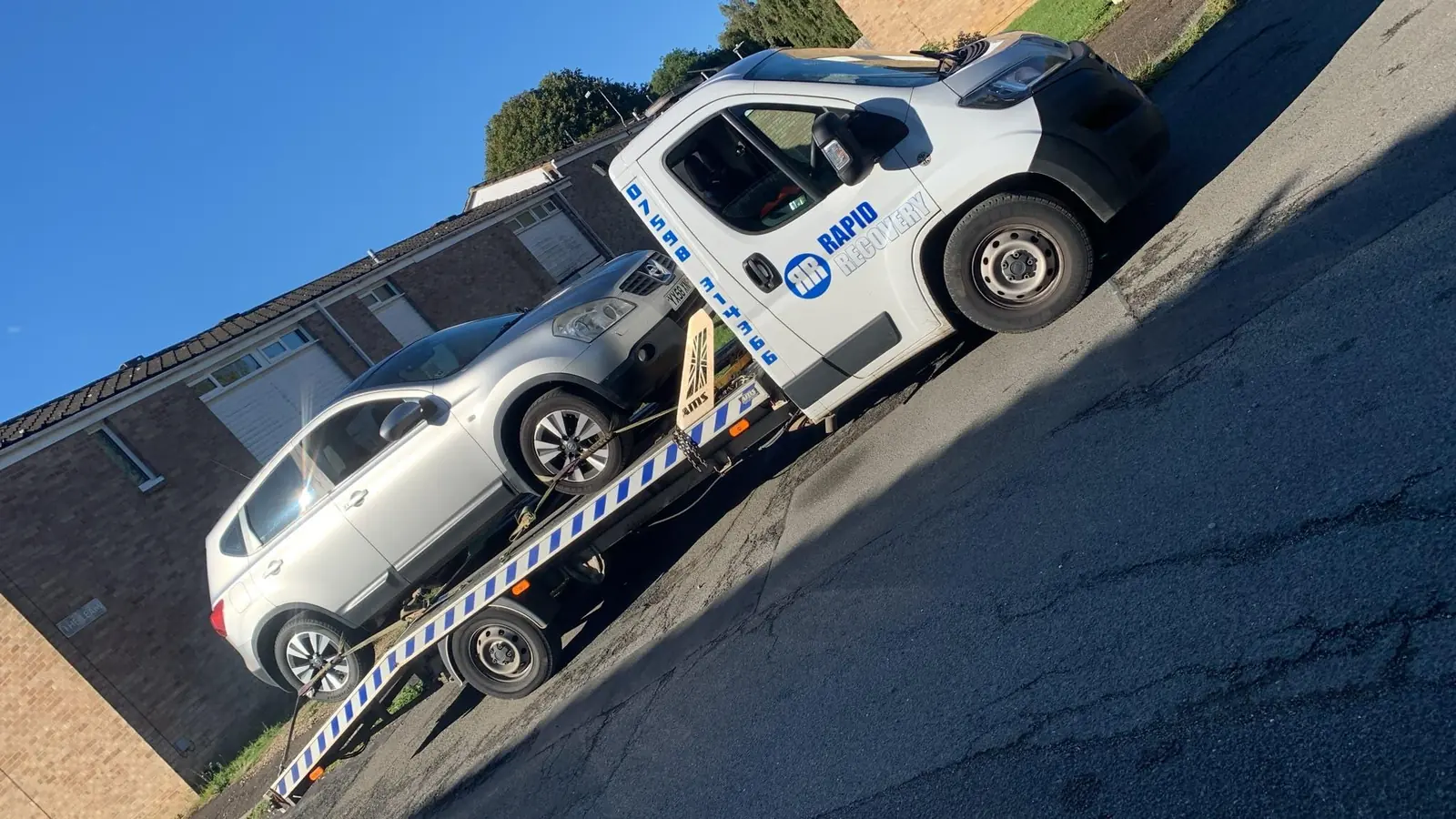
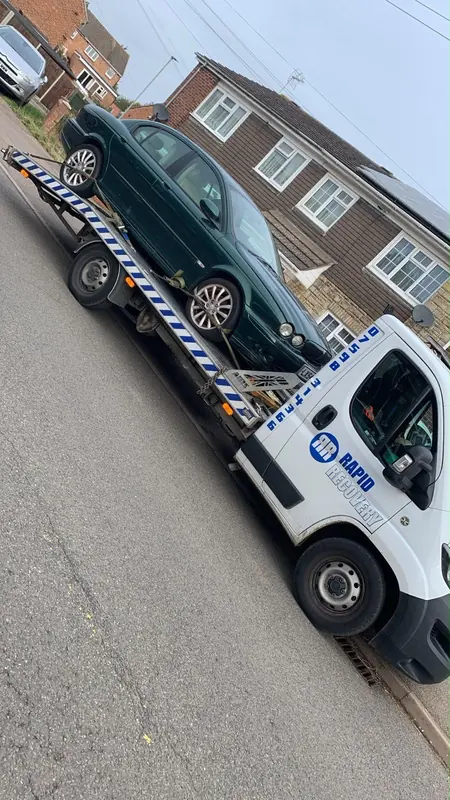
Depending on the vehicle, we use a spec lift for a quick tow or a beavertail tilt-and-slide transporter for low cars and non-runners. We recover cars, vans up to 3.5 tonnes, 4x4s, motorbikes, campervans and classic cars. Some of our trucks can carry one car and tow a second, which helps after a collision involving two vehicles.
Waiting for the truck
Waiting beside a fast road is cold, noisy and uncomfortable, but it is far safer than sitting in the car. Keep your phone on and charged so we can call you back, and keep watching the traffic rather than your screen. If the weather is bad, put a coat on before you get out, not after. When you see the truck arrive, stay behind the barrier until our driver has made the area safe and tells you where to go. Tell us when you call if anyone in the group is elderly, unwell or has young children, so we know what to expect.
Where we can take you
From the A14 or any fast road around Kettering and Corby, we can take you and your vehicle to:
- Your home
- Your own garage or a dealer
- Our secure storage yard if it's late, or the vehicle has been in an accident and is waiting for an insurance decision
We also recover anywhere in the UK. If you have broken down on the A14 far from home, we can bring you back to Corby or Kettering, or take you on to your destination. Long-distance moves can also be arranged as car transport.
What it costs
Local breakdown recovery has a £60 minimum charge. Recoveries from the A14 and further afield are priced on the phone before we set off, based on distance, the vehicle and how easy it is to load. Our breakdown recovery cost guide explains more. You can pay by card on the day, bank transfer or cash.
After a collision on the A14
If you have been in an accident, call 999 if anyone is hurt or the road is blocked. Exchange details with the other driver when it is safe. We carry out accident recovery and work with insurance and accident management companies.
Areas near the A14 we cover
We regularly cover the A14 around Kettering, Rothwell and Desborough, as well as Corby and the A6116 towards Brigstock, which links through to the A14. Save 07598 314366 in your phone, or contact us for non-urgent jobs.
Last updated 14 October 2026 by Rapid Recovery Corby.
Helpful guides
Questions people ask
What should I do if I break down on the A14?
Get onto the verge, a lay-by or off at an exit if you can, hazards on, then get everyone out on the left and stand behind the barrier. Call for recovery once you are safe. If you are stuck in a live lane, call 999.
Should I put a warning triangle out on the A14?
No. Don't use a warning triangle on a fast dual carriageway. Walking along the carriageway to place it is too dangerous.
How do I tell you where I am on the A14?
Share your WhatsApp live location to 07598 314366, or give a what3words address. Otherwise, read the number on the nearest marker post and tell us the last junction you passed and your direction of travel.
Can you change a tyre on the A14?
On a fast road, we normally recover the vehicle to a safe place first rather than work in the live carriageway. The tyre can then be changed away from traffic.
How much does it cost to be recovered from the A14?
Local breakdown recovery has a £60 minimum charge. A14 recoveries are priced on the phone before we set off, depending on distance, the vehicle and where it needs to go.
Do you cover the A14 at night?
Yes. We are open 24 hours a day, 7 days a week, including nights, weekends and bank holidays.
Can you take my car home if I break down far from Corby?
Yes. We recover and transport vehicles anywhere in the UK. Call us for a price.